
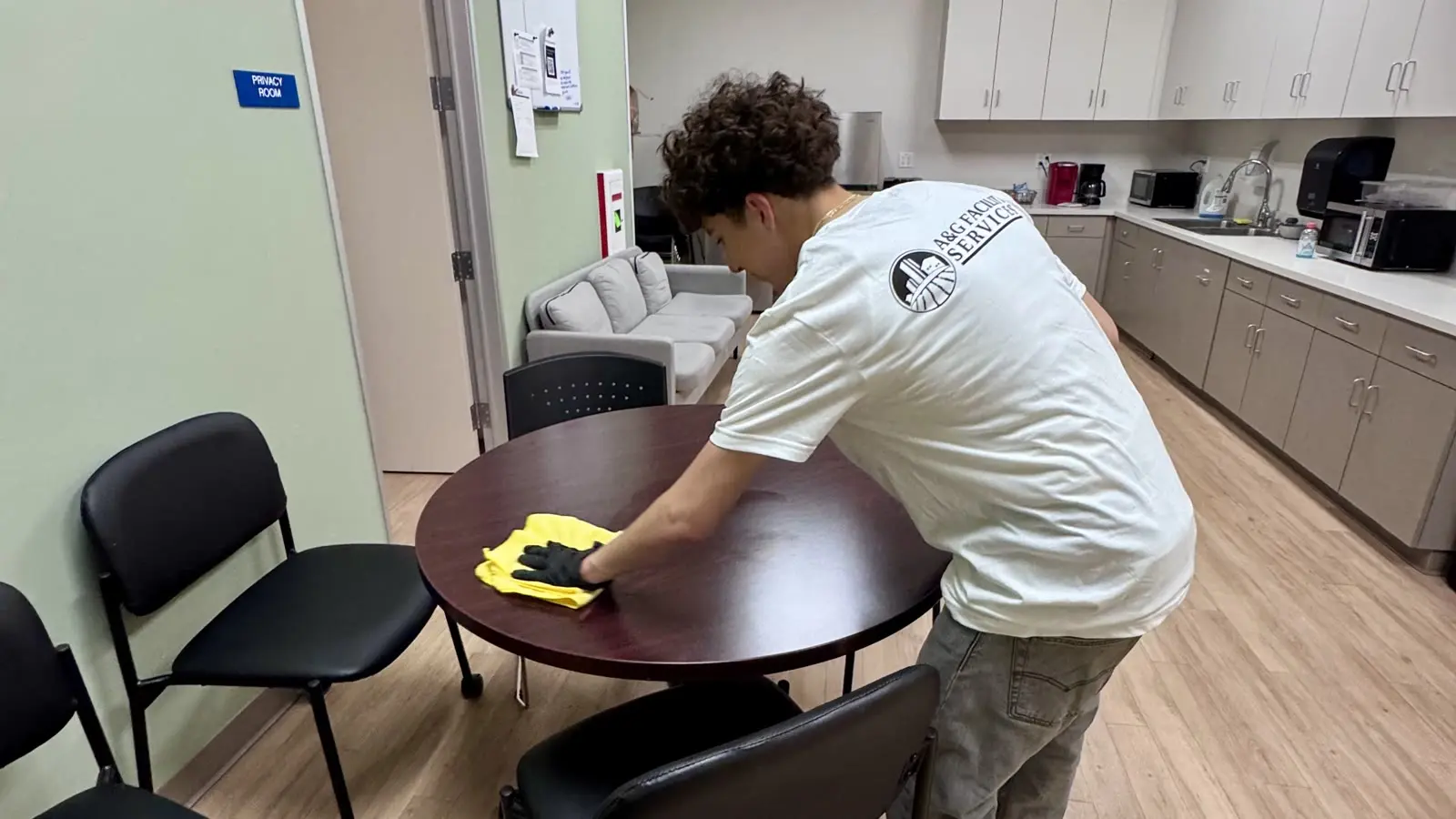
Commercial Cleaning
Disinfecting vs Sanitizing vs Cleaning
Cleaning removes dirt and germs with soap or detergent. Sanitizing reduces the bacteria left after cleaning. Disinfecting uses an EPA-registered product to kill viruses and bacteria, but only if the surface stays wet for the full contact time on the label.
A&G Facility Cleaning ServicesPublished Updated 5 min read
Key takeaways
- Cleaning always comes first, because dirt and residue block sanitizers and disinfectants from reaching germs.
- EPA describes sanitizers as killing bacteria, not viruses, while disinfectants kill both viruses and bacteria.
- A disinfectant only works if the surface stays wet for the full contact time printed on the label.
- Most office surfaces need routine cleaning, with disinfection focused on high-touch points, restrooms and areas where someone was sick.
- Medical offices have extra rules: OSHA requires a written cleaning schedule and disinfection of surfaces contaminated with blood.
On this page
- The short answer: three different jobs
- Why cleaning has to come first
- EPA registration numbers and contact time
- When an office needs each step
- Schools and child care spaces
- Medical and dental offices
- Common mistakes that waste product
- Getting help in Salinas and Monterey County
- Cleaning, sanitizing and disinfecting at a glance
- Questions people ask
The short answer: three different jobs
Cleaning, sanitizing and disinfecting are three separate steps, and each one does something the others do not.
The U.S. Environmental Protection Agency puts it plainly. Cleaning removes dirt and organic matter from surfaces using soap or detergents. Sanitizing kills bacteria on surfaces using chemicals, and it is not intended to kill viruses. Disinfecting kills viruses and bacteria on surfaces using chemicals.
The CDC describes the same order in its guidance for facilities. Cleaning with soap or detergent decreases the number of germs on surfaces. Sanitizing reduces the remaining germs after cleaning. Disinfecting can kill harmful germs that remain on surfaces after cleaning.
Notice the words "after cleaning" in both definitions. Sanitizing and disinfecting are not shortcuts. They are what you do once the surface is already clean. A spray bottle used on a sticky counter mostly moves grime around.
RelatedJanitorial Service in Salinas and Monterey CountyWhy cleaning has to come first
Cleaning comes first because soil, grease and residue protect germs from chemicals and can weaken the product itself.
The EPA's six steps for safe and effective disinfectant use say to wash the surface with soap and water if the directions mention pre-cleaning or if the surface is visibly dirty. Many labels call this a pre-clean step. If the label says one-step, the product is designed to clean and disinfect in one pass on lightly soiled surfaces, but it still needs the full contact time.
In practice, a good crew works like this:
- Remove trash, crumbs and loose debris.
- Clean with a detergent and a fresh microfiber cloth, working from clean areas toward dirty ones.
- Apply a sanitizer or disinfectant only where it is called for.
- Leave it wet for the label time, then wipe or let it air dry as directed.
Skipping step 2 is a common mistake in break rooms and restrooms. It makes the place smell like chemicals without making it much cleaner.
RelatedHow a nightly janitorial service handles routine cleaningEPA registration numbers and contact time
A real disinfectant has an EPA registration number on the label, and it only works when you follow the contact time.
The EPA's first step is to find the EPA registration number on the product. That number tells you the product's claims were reviewed by the agency. The label then lists use sites and surface types, so you can confirm it is meant for the surface in front of you, such as hard nonporous counters or food contact surfaces.
Contact time, sometimes called dwell time, is the number of minutes the surface must stay wet for the product to kill the germs listed. The EPA says the surface should remain wet the whole time to ensure the product is effective. The CDC gives the same instruction: leave the disinfectant on long enough to kill the germs, and keep the surface wet during the entire contact time.
This is where most disinfecting fails. A quick spray and wipe often dries in seconds. If the label says several minutes, the surface may need a second application or a wetter wipe. If you want a lower-hazard option, the EPA's Design for the Environment (DfE) logo helps buyers identify antimicrobial products that EPA has reviewed for safety and performance.
RelatedOur medical & dental offices serviceWhen an office needs each step
Most office surfaces need regular cleaning, and disinfection should be targeted, not sprayed on everything.
The CDC advises disinfecting areas of a facility where people have obviously been ill. For high-traffic areas, it says you may choose to clean more frequently or disinfect in addition to cleaning. That gives a simple rule for a typical office:
- Clean daily: desks people agree to clear, floors, trash areas, entry glass, break room tables.
- Clean and disinfect daily: restroom fixtures, door handles, shared kitchen handles, elevator buttons, faucet handles.
- Sanitize: food contact surfaces in the break room, using a product labeled for food contact and rinsing if the label says so.
- Disinfect right away: any surface touched by someone who was visibly sick, and anything with vomit or other body fluids.
The CDC lists common high-touch surfaces as pens, counters, shopping carts, door handles, stair rails, elevator buttons, touchpads, restroom fixtures and desks. Shared keyboards, phone handsets and copier panels belong on the same list. Check the device maker's instructions before using liquids on electronics.
RelatedA daily, weekly and monthly office cleaning checklistSchools and child care spaces
Schools need the same three steps, with extra care around product choice and where children eat.
Classrooms have more shared surfaces per square foot than most offices: desks, chair backs, cubbies, water fountains, light switches and shared supplies. Daily cleaning handles most of that. Disinfection makes sense on restroom fixtures, door hardware, fountains and any desk or surface where a student was sick.
Lunch tables and food prep counters call for a food contact sanitizer used exactly as labeled. Products should be stored closed and out of reach, which is step six on the EPA's list. Schedule disinfecting after students leave when you can, so surfaces have time to stay wet for the full contact time and dry before anyone touches them again.
RelatedSchool and classroom cleaningMedical and dental offices
Medical and dental offices have legal requirements that general offices do not, so disinfection there is a written process, not a judgment call.
OSHA's Bloodborne Pathogens standard (29 CFR 1910.1030) requires employers to keep the worksite clean and sanitary and to set a written schedule for cleaning and method of decontamination, based on the location, type of surface, type of soil and tasks performed. It also requires contaminated work surfaces to be decontaminated with an appropriate disinfectant after procedures, immediately or as soon as feasible after a spill of blood or other potentially infectious materials, and at the end of the shift if the surface may have been contaminated.
For a cleaning contractor, that means the clinic's written schedule should spell out which rooms get disinfected, with which registered product, and how often. Exam rooms, waiting room arm rests, check-in counters and restrooms usually top the list. Clinical staff typically handle surfaces between patients, and the cleaning crew handles terminal cleaning at the end of the day.
RelatedMedical and dental office cleaningCommon mistakes that waste product
Most disinfecting problems come from using the right product the wrong way.
- Spraying a dirty surface. Clean first.
- Wiping too soon. Respect the contact time.
- Mixing chemicals. Never combine products unless the label says it is safe.
- Using one cloth for the whole building. Use separate, color-coded cloths for restrooms and kitchens.
- Diluting by eye. Concentrates need the ratio on the label, measured.
- Disinfecting everything. It costs more, adds residue and does not replace cleaning.
A written plan solves most of this. List each area, the step it needs, the product and the frequency, and keep the product labels where the crew can read them.
RelatedA room-by-room medical office cleaning checklistGetting help in Salinas and Monterey County
If you want cleaning, sanitizing and disinfecting written into one clear plan, a commercial cleaning crew can set it up area by area.
A&G Facility Cleaning Services has cleaned offices, schools, medical offices, government facilities and community buildings in Salinas, Monterey, Seaside, Carmel, Hollister and Watsonville for more than 15 years. We are licensed and insured, and estimates are free. Call (831) 208-1314 to walk through your space and talk about which areas need daily disinfection and which only need a good clean.
RelatedCommercial cleaning across Monterey CountyCleaning, sanitizing and disinfecting at a glance
Based on EPA and CDC definitions. Always follow the product label for use sites and contact time.
| Step | What it does | Where to use it in a business |
|---|---|---|
| Cleaning | Removes dirt and organic matter with soap or detergent, lowering the number of germs | Every surface, every visit. Always the first step. |
| Sanitizing | Reduces bacteria left after cleaning. EPA notes it is not intended to kill viruses. | Food contact surfaces in break rooms and kitchens, using a food contact product |
| Disinfecting | Kills viruses and bacteria when the surface stays wet for the label contact time | Restroom fixtures, door handles, shared high-touch points, areas where someone was sick |
| Blood or body fluids | Clean up, then disinfect with an appropriate registered product per OSHA rules | Medical and dental offices, nurse rooms, any spill cleanup |
Cleaning
- What it does
- Removes dirt and organic matter with soap or detergent, lowering the number of germs
- Where to use it in a business
- Every surface, every visit. Always the first step.
Sanitizing
- What it does
- Reduces bacteria left after cleaning. EPA notes it is not intended to kill viruses.
- Where to use it in a business
- Food contact surfaces in break rooms and kitchens, using a food contact product
Disinfecting
- What it does
- Kills viruses and bacteria when the surface stays wet for the label contact time
- Where to use it in a business
- Restroom fixtures, door handles, shared high-touch points, areas where someone was sick
Blood or body fluids
- What it does
- Clean up, then disinfect with an appropriate registered product per OSHA rules
- Where to use it in a business
- Medical and dental offices, nurse rooms, any spill cleanup
Questions people ask
What is the difference between a disinfectant and a sanitizer?
According to the EPA, a sanitizer kills bacteria on surfaces and is not intended to kill viruses, while a disinfectant kills both viruses and bacteria. Both work only on a surface that has already been cleaned, and both must be used as the label directs. The label tells you which one you have, the germs it covers and how long the surface must stay wet.
Is disinfecting better than sanitizing?
Disinfecting kills a wider range of germs, but it is not always the better choice. Food contact surfaces often call for a sanitizer labeled for that use. Disinfecting every surface adds cost and residue without replacing cleaning. The CDC suggests disinfecting where someone has been ill and adding disinfection in high-traffic areas, while routine cleaning covers the rest.
How can I tell if a cleaning spray is a sanitizer or a disinfectant?
Read the label. A disinfectant or sanitizer has an EPA registration number and lists the germs it controls, the surfaces it is meant for and the contact time. If the label only talks about removing dirt and has no registration number, it is a cleaner. The EPA suggests checking disinfectant registration numbers against its List N lookup at epa.gov/listn.
Can hypochlorous acid be used to sanitize or disinfect?
It depends on the specific product, not the ingredient name. Some products made with hypochlorous acid are registered with the EPA and appear on its List N of disinfectants and carry sanitizer or disinfectant claims, and others are sold without those claims. Look for an EPA registration number, check the use sites and surfaces on the label, and follow the stated contact time. If there is no registration number, treat it as a cleaner.
How long should a disinfectant sit before wiping?
As long as the label says. That time, called contact time or dwell time, varies by product and by germ, so check every product you use. The EPA and CDC both say the surface must stay wet for the entire contact time. If the product dries early, reapply it or use a wetter wipe so it can do its job.
Who offers commercial disinfection and janitorial service in Salinas?
A&G Facility Cleaning Services, at 161 Main St #3 in Salinas, provides janitorial, office and commercial cleaning for offices, schools, medical offices, government facilities and churches across Monterey County. The company has been in business for more than 15 years, is licensed and insured, and offers free estimates. You can reach the office at (831) 208-1314.
Sources
We checked the facts in this guide against these sources.
- 1.What's the difference between products that disinfect, sanitize, and clean surfaces?, U.S. Environmental Protection Agency
- 2.When and How to Clean and Disinfect a Facility, Centers for Disease Control and Prevention
- 3.6 Steps for Safe and Effective Disinfectant Use, U.S. Environmental Protection Agency
- 4.Learn About Design for the Environment (DfE) Certification, U.S. Environmental Protection Agency
- 5.Bloodborne Pathogens Standard, 29 CFR 1910.1030, Occupational Safety and Health Administration
- 6.List N Advanced Search Page: Disinfectants for Coronavirus (COVID-19), U.S. Environmental Protection Agency
Keep reading
 5 min read
Commercial Cleaning
Medical Office Cleaning Checklist by Room
A medical office checklist covers exam rooms, the waiting room, front desk, restrooms and floors, with high-touch surfaces cleaned and disinfected more often than low-touch ones. Use EPA-registered disinfectants by the label, follow the OSHA bloodborne pathogens rules, and split tasks clearly between cleaners and clinical staff.
 5 min read
Commercial Cleaning
Office Cleaning Checklist: Daily to Quarterly
A good office cleaning checklist splits the work by area and by frequency. Daily: trash, restrooms, break room, high-touch points and main floors. Weekly: detailed dusting, glass and edges. Monthly: vents and high dusting. Quarterly: deep carpet cleaning and hard floor refinishing.
 6 min read
Floors, Tile & Dusting
Floor Stripping and Waxing: The Process, How Often, and What It Costs
Floor stripping and waxing removes the old, dirty finish down to the bare tile, then lays down fresh coats of floor finish. Many floors only need a scrub and recoat. A full strip is for finish that is yellowed, built up, or worn through.
Need janitorial service in Monterey County?
Tell us about your property and we will send a free, no-obligation estimate.