
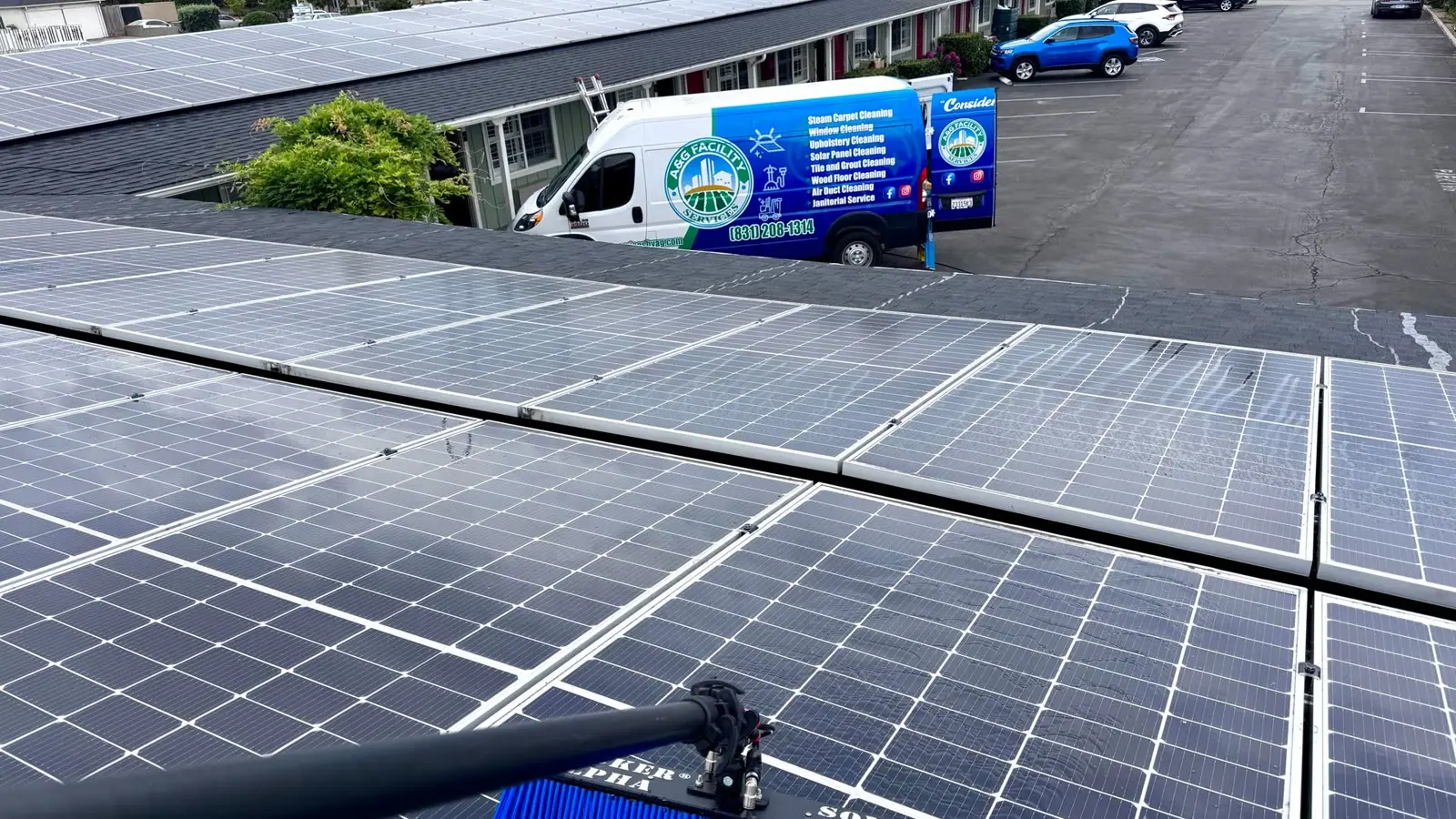
Windows & Solar
Solar Panel Cleaning: Cost, Frequency, Results
Cleaning helps when panels are actually dirty: research from NREL and UC San Diego shows losses from a few percent to over 10 percent, with farm dust, pollen, bird droppings and flat tilt making it worse. Most systems need cleaning once or twice a year; nationally it costs about $142 to $310.
A&G Facility Cleaning ServicesPublished 7 min read
Key takeaways
- NREL researchers report annual soiling losses from about 0.5 percent in rainy, temperate climates to 30 percent in deserts.
- A UC San Diego study of 186 California systems found a 7.4 percent loss after a 145-day dry summer, and said cleaning pays off mainly near fields, highways, bird droppings or on flat panels.
- Manufacturers limit water pressure, water hardness and chemicals, and improper cleaning can void a module warranty.
- Thumbtack's 2026 national data puts solar panel cleaning at about $142 to $310, with most people paying around $209.
On this page
- Does cleaning solar panels increase efficiency?
- What California research says
- Pollen and rain: why one storm may not be enough
- Salinas Valley conditions: farm dust, wind and birds
- How often to clean solar panels
- Manufacturer cautions: pressure, water and chemicals
- Solar panel cleaning cost
- Can you clean solar panels yourself, and where to get help
- How often to clean solar panels by site
- Questions people ask
Does cleaning solar panels increase efficiency?
Yes, when the panels are dirty enough to block light, and how much depends on where they are. Soiling is the term for dust, pollen and other material that keeps sunlight from reaching the cells. In a 2023 paper, researchers at the National Renewable Energy Laboratory (NREL) wrote that annualized soiling losses can be as low as 0.5 percent per year in temperate climates with frequent rain and as high as 30 percent per year in deserts.
The same NREL paper modeled 16 sites in the Southwest U.S. over 20 years and found average soiling losses between 4.3 and 15.5 percent, depending on the site. In other words, two systems in the same region can have very different dirt problems.
That range explains why advice online conflicts. Some homeowners never clean and see little change. Others, near fields, dirt roads or trees, lose real production. The way to know is to watch your own system. Most inverters and monitoring apps show daily output. Compare a clear day now with a clear day at the same time last year, or with output right after a good rain. A steady drop that recovers after rain is a sign of soiling, not equipment failure.
RelatedSolar Panel Cleaning in Salinas and Monterey CountyWhat California research says
California's dry summers make soiling more noticeable here than in rainy states, but the losses for most home systems are modest. A UC San Diego study published in 2013 analyzed output from 186 residential and commercial systems from the San Francisco Bay Area to the Mexico border. Panels that went 145 days without rain during a summer drought lost 7.4 percent of their efficiency, or a little under 0.05 percent per day on average.
For a typical 5 kilowatt home system, the researchers estimated that washing halfway through that summer would have gained only about $20 in electricity. Their conclusion was that most homeowners would not get their money back from routine paid cleaning.
The same study listed clear exceptions where cleaning is worth it:
- Panels heavily soiled with bird droppings, which block nearly all light and do not wash off in rain.
- Panels directly next to and downwind of a highway, factory or agricultural field.
- Panels mounted at an angle of less than five degrees, where dirt does not slide off.
- Very large installations, where economies of scale can make washing pay.
Several of those exceptions describe common Salinas Valley sites.
RelatedOur window cleaning servicePollen and rain: why one storm may not be enough
Rain helps, but it does not always restore full output. In a 2023 study of five utility-scale solar plants in North Carolina, NREL and partner researchers found that spring pollen cut performance by as much as 15 percent during peak pollen season. Rain washed away some pollen but did not bring output back to its earlier clean level, even after the pollen season ended.
The researchers estimated that without planned cleaning, annual losses at those sites could be on the order of 10 percent. After mechanical wet brush cleaning, measured performance rose by 5 to 11 percent. Those plants had gone more than seven years without manual cleaning.
North Carolina is not the Central Coast, but the lesson carries over. Sticky materials such as pollen, bird droppings and fine dust that gets damp from fog or irrigation bond to glass and resist light rain. If your output stays low after the first storms of the season, the panels probably need a real cleaning rather than more waiting.
RelatedCleaning services in Salinas, CASalinas Valley conditions: farm dust, wind and birds
The Salinas Valley has several of the conditions the research links to heavier soiling. Agricultural fields surround much of the valley, and the UC San Diego study specifically named panels downwind of an agricultural field as a case where cleaning can be warranted. Afternoon wind moves that soil. In a June 2025 forecast discussion, the National Weather Service called for afternoon gusts of 25 to 30 mph through gaps, passes and the Salinas Valley.
Other local factors:
- Long dry season. Little rain falls for months, so dust builds without being rinsed.
- Morning fog and irrigation mist. Damp dust dries into a film that sticks harder than loose dust.
- Birds. Gulls and other birds roost on roofs near fields and the coast, and droppings block light completely.
- Flat commercial roofs. Low-tilt arrays on warehouses and offices hold dirt and standing water.
- Sea salt. Closer to the coast, the UC San Diego researchers list sea salt among the materials that build up on panels.
A home on a hillside in Carmel Valley and a warehouse next to a lettuce field in Salinas can need very different schedules.
RelatedCleaning services for Salinas homes and businessesHow often to clean solar panels
Most systems need cleaning once or twice a year, and some need none beyond rain. Thumbtack's 2026 cost guide says industry experts recommend twice a year. The research above suggests a better rule: clean when your monitoring shows a loss that rain does not fix, and clean more often if your site matches the high-soiling cases.
A practical approach for the Central Coast:
- Check output monthly against the same month last year, on clear days.
- Look at the panels from the ground or a window with binoculars after the dry season. Visible dust film, bird droppings or debris along the bottom edge are signs.
- Clean at the end of the dry season if output has slipped, so the panels are clear for the stronger sun of the following year.
- Spot-clean bird droppings as soon as you notice them.
- Add a cleaning after nearby construction, field work or a dust event.
Use the table below as a starting point by site type, and adjust once you have a year of monitoring data.
RelatedOur solar panel cleaning serviceManufacturer cautions: pressure, water and chemicals
Cleaning the wrong way can damage panels and void the warranty, so read your module manual before anyone touches the array. First Solar's module cleaning guidelines are a good example of what manufacturers require:
- Low pressure only. Water pressure must not exceed 35 bar (500 psi) at the nozzle, and water should not be sprayed directly at junction boxes, edge seals or connectors.
- Water temperature close to the panel. Do not apply water more than 20 degrees Celsius warmer or colder than the module surface.
- No harsh chemicals. No abrasive cleaners or degreasers, and no solutions containing hydrochloric acid, ammonia, D-limonene or sodium hydroxide.
- Soft, non-conductive brushes only.
- Mineral limits. Tap water should have total hardness below 75 mg/L; harder water up to 180 mg/L must be squeegeed off.
- Electrical safety. Clean only when the circuit is open or the inverter is off, ideally from dusk to dawn, because daylight voltage can cause a lethal shock.
First Solar states that failure to follow its guidelines may void the warranty. Water hardness matters locally: California Water Service reports an average of 254 parts per million in its Salinas District system, so untreated tap water leaves mineral spots. Professionals use filtered or deionized water.
RelatedOur professional window cleaning serviceSolar panel cleaning cost
Nationally, most people pay about $142 to $310 for professional solar panel cleaning, with most paying around $209, according to Thumbtack's 2026 cost guide. Its national low and high ends are $81 and $557.
Thumbtack lists the main price factors as location, local labor costs, the number of panels, how many stories the home has and how easy the panels are to reach. Cleaners usually charge in one of two ways:
- Per panel, which suits small and medium arrays.
- Flat rate up to a set number of panels, with a per-panel charge above that.
Commercial arrays on warehouses, schools and offices are usually quoted after a site visit, since roof access, safety setup and panel count vary widely. Large accounts often pay less per panel.
To decide whether cleaning is worth the price, compare it with your production loss. If monitoring shows a 7 percent drop on a system that produces a few hundred dollars of power a month during the dry season, the math is easy. If output is within a percent or two of last year, wait.
RelatedOur solar panel cleaning serviceCan you clean solar panels yourself, and where to get help
You can rinse ground-mounted or easily reached panels yourself if you follow the manufacturer's rules, but rooftop work is where most homeowners should stop. The Occupational Safety and Health Administration notes that falls from portable ladders are one of the leading causes of work-related deaths and injuries. Wet panels are slippery, and walking on them can crack the glass.
If you do it yourself, shut the system down using your installer's procedure, work early in the morning or late in the day, use a soft brush and low-pressure water, and squeegee or dry the glass if your water is hard. Never use a pressure washer or household chemicals.
A&G Facility Cleaning Services, at 161 Main St in Salinas, cleans solar panels for homes and businesses in Salinas, Monterey, Carmel Valley, Hollister, Watsonville and nearby communities. The company is licensed and insured, and estimates are free. Call (831) 208-1314 and have your panel count and roof height ready.
RelatedWhat window cleaning costs if you want both done in one visitHow often to clean solar panels by site
Starting points based on the soiling factors in the NREL and UC San Diego research. Your monitoring data is the final word.
| Site | Soiling risk | Suggested cleaning |
|---|---|---|
| Steep roof, away from fields and roads | Low | Only when monitoring shows a loss rain does not fix |
| Coastal home with fog and salt | Low to moderate | Once a year, plus spot cleaning of droppings |
| Downwind of farm fields or dirt roads | High | Twice a year, including the end of the dry season |
| Under trees or near bird roosts | Moderate to high | Spot-clean droppings promptly; full cleaning once or twice a year |
| Flat or low-tilt commercial array | High | Two or more times a year, based on output data |
| Near active construction | High while work lasts | Clean after dusty work ends |
Steep roof, away from fields and roads
- Soiling risk
- Low
- Suggested cleaning
- Only when monitoring shows a loss rain does not fix
Coastal home with fog and salt
- Soiling risk
- Low to moderate
- Suggested cleaning
- Once a year, plus spot cleaning of droppings
Downwind of farm fields or dirt roads
- Soiling risk
- High
- Suggested cleaning
- Twice a year, including the end of the dry season
Under trees or near bird roosts
- Soiling risk
- Moderate to high
- Suggested cleaning
- Spot-clean droppings promptly; full cleaning once or twice a year
Flat or low-tilt commercial array
- Soiling risk
- High
- Suggested cleaning
- Two or more times a year, based on output data
Near active construction
- Soiling risk
- High while work lasts
- Suggested cleaning
- Clean after dusty work ends
Questions people ask
Is it worth it to have solar panels cleaned?
It is worth it when your panels are losing measurable output. A UC San Diego study found typical California home systems lost 7.4 percent after a 145-day dry summer and said routine paid cleaning rarely paid off, except for panels near farm fields or highways, heavily covered in bird droppings, or tilted under five degrees. Check your monitoring data first and clean when output drops and rain does not restore it.
How frequently do solar panels need to be cleaned?
Most solar panels need cleaning once or twice a year, and some need nothing beyond rain. Thumbtack's 2026 cost guide says industry experts recommend twice a year. Panels downwind of farm fields, under trees, on flat roofs or near construction need cleaning more often. The best guide is your own output data: clean when production drops on clear days and stays low after rain.
Can I clean solar panels myself?
Yes, if you can reach them safely and follow the manufacturer's rules. Use a soft, non-abrasive brush and low-pressure water, never a pressure washer or harsh chemicals. First Solar's guidelines, for example, cap pressure at 500 psi and ban ammonia and acids. Shut the system down first, and squeegee hard water off the glass. Rooftop panels are safer left to a professional because of ladder and fall risk.
How much does it cost to have solar panels cleaned?
Thumbtack's 2026 national cost guide puts professional solar panel cleaning at about $142 to $310, with most people paying around $209. The national low end is $81 and the high end is $557. Price depends on the number of panels, roof height, access and local labor costs. Cleaners charge per panel or a flat rate up to a set number of panels.
Do I need to turn off solar panels before cleaning?
Yes, follow your installer's shutdown procedure before cleaning. First Solar's cleaning guidelines say modules should be cleaned only when the circuit is open or the inverter is not operating, and recommend cleaning from dusk to dawn, because the voltage and current in an array during daylight can cause a lethal shock. Inspect panels for cracks first, since damaged modules are a shock hazard when wet.
Who offers solar panel cleaning in Salinas?
A&G Facility Cleaning Services, based at 161 Main St #3, in Salinas, offers solar panel cleaning for homes and businesses across Monterey County, including Salinas, Monterey, Carmel Valley, Seaside, Hollister and Watsonville. The company has more than 15 years in business, is licensed and insured, and provides free estimates. Call (831) 208-1314 to request one.
Sources
We checked the facts in this guide against these sources.
- 1.Considering the Variability of Soiling in Long-Term PV Performance Forecasting (NREL/CP-5K00-85776), National Renewable Energy Laboratory
- 2.NREL Research Finds Rain Not Enough To Wash Pollen From Solar Panels, National Renewable Energy Laboratory
- 3.Cleaning Solar Panels Often Not Worth the Cost, Engineers at UC San Diego Find, University of California San Diego
- 4.FS-Series PV Module Cleaning Guidelines, First Solar
- 5.Solar panel cleaning cost, Thumbtack
- 6.2024 Water Quality Report, Salinas District, California Water Service
- 7.Area Forecast Discussion, San Francisco Bay Area and Monterey, June 18, 2025, National Weather Service (archived by Iowa Environmental Mesonet)
- 8.Portable Ladder Safety QuickCard, Occupational Safety and Health Administration
Keep reading
 6 min read
Windows & Solar
Window Cleaning Cost: What You Will Pay and Why Prices Vary
Professional window cleaning for a home typically costs about $184 to $387 nationally, with most people paying around $266, according to Thumbtack's 2026 data. Your price depends on the number of panes, height, access, screens, tracks and hard water spots.
 6 min read
Windows & Solar
How Often Should Commercial Windows Be Cleaned?
Most commercial buildings need exterior glass cleaned at least twice a year, the baseline the glass industry gives. Storefronts, entrances and restaurants need it every one to four weeks, and windy, dusty Salinas Valley sites often need it sooner.
 5 min read
Pressure & Soft Washing
Pressure Washing Cost: Prices and What Drives Them
Most pressure washing jobs land between about $217 and $459 according to Thumbtack's national data, while Fixr puts a full house wash near $500 to $900. Size, surface, access, stains and water handling explain the gap.
Need solar panel cleaning in Monterey County?
Tell us about your property and we will send a free, no-obligation estimate.