
Carpet & Upholstery
Carpet Cleaning Methods Compared: Which Is Best?
Hot water extraction is the most thorough method and the one carpet makers require for deep cleaning. Encapsulation and dry compound are fast, low-moisture interim methods that keep carpet presentable between extractions. Carpet makers advise against bonnet and rotary shampoo machines.
A&G Facility Cleaning ServicesPublished Updated 5 min read
Key takeaways
- Interface calls hot water extraction the most effective restorative method and the only one it recommends for deep cleaning.
- Encapsulation typically dries in 30 to 60 minutes and dry compound needs about 30 minutes before vacuuming, per Interface.
- Shaw recommends hot water extraction after every third or fourth encapsulation, because interim methods do not replace it.
- Shaw does not recommend bonnet cleaning, and Interface warns that bonnet or rotary machines may void warranties.
- Any method that leaves detergent in the carpet leads to fast re-soiling, so rinsing and measured chemistry matter more than the machine.
On this page
Two jobs: restorative and interim
Carpet cleaning methods fall into two groups, and the right choice depends on which job you need done. Restorative cleaning removes soil from deep in the pile. Interim cleaning freshens the surface between restorative cleanings without long drying times.
Interface's carpet tile maintenance guidelines describe it this way: interim cleaning uses several possible methods and can prolong the need for restorative cleaning, while restorative cleaning is deep cleaning to remove trapped soils. Interface names hot water extraction as the most effective restorative method and the only one it recommends.
So the question is rarely which single method is best. It is which method fits this area, at this point in the schedule. A lobby might get encapsulation monthly and extraction quarterly. A private office might only need extraction once a year. Knowing the difference lets you read a bid and see what you are really paying for.
RelatedProfessional carpet cleaning with hot water extractionHot water extraction (steam cleaning)
Hot water extraction is what most people mean by steam cleaning, and it is the deepest clean available. Shaw Floors uses the terms together, recommending professional hot water extraction (steam cleaning). A 2018 Cleaning and Maintenance Management article describes the process: operators inject hot water and detergent into the carpet at high pressure, and the soil is pulled into a wastewater recovery tank.
Interface's process starts with vacuuming, then a pre-spray, agitation with a counter-rotating brush and 10 minutes of dwell time, then rinsing with clean water. It recommends water between 110 and 130 degrees Fahrenheit and notes truck-mounted units typically run hotter.
Drawbacks: it takes the longest to dry. Interface says to plan on at least three hours under normal conditions and to keep foot traffic off until the carpet is dry. Done poorly, it can over-wet carpet. Done well, it is what Mohawk and Shaw warranties require on a regular cycle.
RelatedTruck-mounted vs portable extraction equipmentEncapsulation
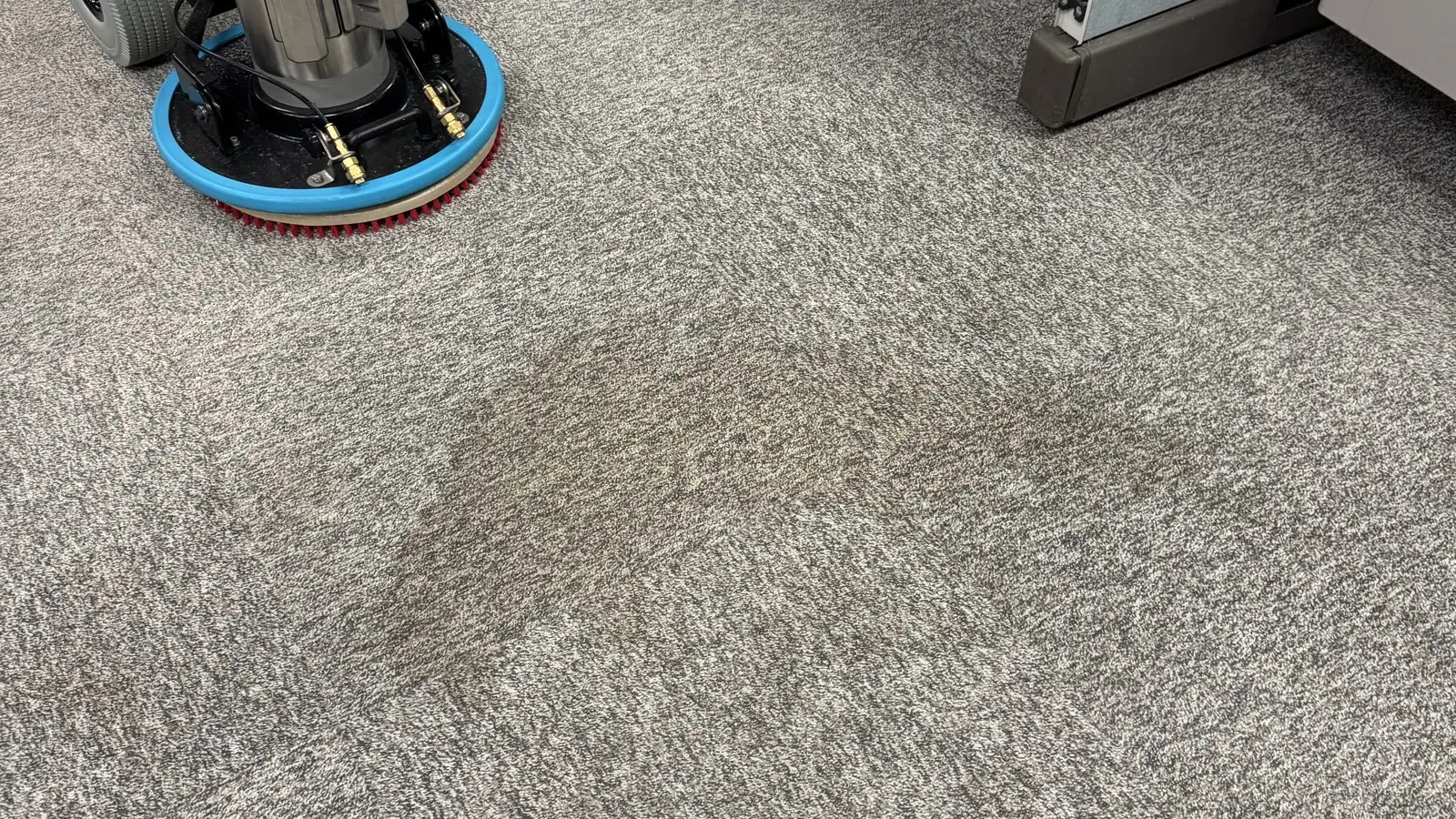
Encapsulation is the most common interim method for commercial carpet because it cleans the surface and dries fast. Interface describes it as a low-moisture process: a liquid solution is sprayed on, brushed into the pile with a counter-rotating brush machine, and dries into small crystals that hold the soil. The crystals are then vacuumed out. Drying time is typically 30 to 60 minutes.
The 2018 CMM article explains that the detergent surrounds carpet fibers and crystallizes as it dries. In its 2014 pricing guide, CMM listed production rates of 1,500 to 2,000 square feet per hour with a planetary head machine, which is why encapsulation suits large floors cleaned overnight.
Drawbacks: it does not flush soil out of the base of the pile. Shaw's commercial checklist recommends hot water extraction after every third or fourth encapsulation and says to always pre-vacuum and use CRI-certified agents with a pH between 6 and 8.
RelatedWhere encapsulation fits in a commercial carpet programBonnet cleaning
Bonnet cleaning is fast, but major carpet makers advise against it. The 2018 CMM article describes it as a spinning machine that uses a cotton bonnet pad to absorb carpet soil, with minimal moisture, which is why it has been used for interim cleaning.
The concern is what the spinning pad does to the fibers and where the soil goes. Shaw's commercial carpet maintenance checklist states plainly that bonnet cleaning is not recommended. Interface's guidelines go further: use of a bonnet or any other type of rotary machine for cleaning or drying is not recommended and may void all warranties.
If a bid for your building includes bonnet cleaning, ask what carpet you have and check its maintenance guide before agreeing. Encapsulation with a cylindrical brush machine is the interim method these manufacturers describe instead. Ask for it in writing.
RelatedCarpet Cleaning in Salinas and Monterey CountyDry compound
Dry compound cleaning uses almost no water, so the area can be used right away. Interface describes it as a moist absorbent compound spread on the carpet and brushed in with a counter-rotating brush machine, where it loosens and absorbs soil. After about 30 minutes, the compound and soil are vacuumed out. The CMM article describes the compound as an absorbent carrier with solvents.
It suits spaces that cannot close, carpet that should not get wet, and quick appearance cleaning in busy areas. CMM's 2014 guide listed dry absorbent powder at 750 to 1,500 square feet per hour.
Drawbacks: it is a surface method, and the compound must be vacuumed out thoroughly so powder does not stay in the pile. Like encapsulation, it is interim cleaning, not a replacement for periodic extraction.
RelatedOur area rug cleaning serviceShampoo and dry foam
Traditional rotary shampooing is the oldest of these methods and the one most likely to leave residue. A rotary machine works a detergent solution into the carpet with a spinning brush. CMM's 2014 guide listed rotary shampoo at 1,000 to 1,500 square feet per hour, and rotary shampoo followed by extraction at 400 to 500.
The main problem is detergent left behind. Mohawk's carpet care guide says cleaning residue that was not rinsed completely leads to matting, and Interface warns that excess detergent causes rapid re-soiling. Interface's caution about rotary machines possibly voiding warranties applies here too.
Dry foam is a related method. CMM describes it as a reel-type machine that applies aerated foam, which is then removed with a wet vacuum. It uses less water than liquid shampoo.
One point in shampooing's favor: a 2017 study in the Journal of Feline Medicine and Surgery found that two passes with an upright beater-brush carpet shampooer removed ringworm spores from test carpet. In that study, hot water extraction dried faster and caused no discoloration.
RelatedWhy carpet can look dirtier after shampooingWhich method fits your space
Match the method to the soil, the carpet and how long the space can be closed.
- Homes: hot water extraction every 6 to 18 months, as Shaw recommends, with spot cleaning in between
- Offices and schools: daily vacuuming, encapsulation in heavy-traffic zones, extraction on a zone schedule
- Spaces that cannot close: encapsulation or dry compound during the day, extraction overnight or on weekends
- Wool and specialty rugs: ask for methods and products approved for that fiber before any cleaning
- Warranty carpet: hot water extraction on the schedule the manufacturer requires, with receipts
Whatever the method, ask the provider which chemistry it uses. Interface describes a simple residue test: dry a little of the solution in a glass dish for 24 hours. If the residue is powdery or crystal, it is acceptable. If it is oily, sticky or waxy, it will cause re-soiling.
RelatedArea rug cleaning for wool and specialty rugsGetting the right method in Salinas and Monterey County
A good provider will recommend different methods for different areas rather than one process for everything. Ask for the plan in writing: which areas get which method, how often, and the expected drying time.
A&G Facility Cleaning Services uses truck-mounted steam cleaning with eco-friendly products for homes and commercial buildings across Salinas, Monterey, Seaside, Carmel, Hollister and Watsonville, and offers free estimates.
RelatedHow long carpet takes to dry by methodCarpet cleaning methods side by side
How each method works, how long it takes to dry, and where it fits. Drying times are from Interface's maintenance guidelines and vary with humidity and air flow.
| Method | How it works and drying time | Best for and drawbacks |
|---|---|---|
| Hot water extraction | Pre-spray, agitate, 10 minute dwell, then hot water rinse pulled into a recovery tank; plan on at least 3 hours to dry | Deep restorative cleaning and warranty upkeep; longest drying time and risk of over-wetting if done poorly |
| Encapsulation | Low-moisture solution brushed in, dries into crystals that are vacuumed out; typically 30 to 60 minutes | Interim cleaning of commercial traffic lanes; does not replace extraction, which Shaw suggests every third or fourth time |
| Bonnet | Spinning cotton pad absorbs surface soil with minimal moisture; dries quickly | Fast surface touch-up; Shaw does not recommend it and Interface says rotary machines may void warranties |
| Dry compound | Moist absorbent powder brushed in, left about 30 minutes, then vacuumed out | Spaces that cannot close or carpet that should stay dry; surface only, powder must be fully removed |
| Rotary shampoo | Detergent worked in with a spinning brush, sometimes followed by extraction | Older method; high risk of residue, matting and re-soiling if not rinsed |
| Dry foam | Aerated foam applied with a reel-type machine, then removed with a wet vacuum | Lower moisture than liquid shampoo; still a surface method |
Hot water extraction
- How it works and drying time
- Pre-spray, agitate, 10 minute dwell, then hot water rinse pulled into a recovery tank; plan on at least 3 hours to dry
- Best for and drawbacks
- Deep restorative cleaning and warranty upkeep; longest drying time and risk of over-wetting if done poorly
Encapsulation
- How it works and drying time
- Low-moisture solution brushed in, dries into crystals that are vacuumed out; typically 30 to 60 minutes
- Best for and drawbacks
- Interim cleaning of commercial traffic lanes; does not replace extraction, which Shaw suggests every third or fourth time
Bonnet
- How it works and drying time
- Spinning cotton pad absorbs surface soil with minimal moisture; dries quickly
- Best for and drawbacks
- Fast surface touch-up; Shaw does not recommend it and Interface says rotary machines may void warranties
Dry compound
- How it works and drying time
- Moist absorbent powder brushed in, left about 30 minutes, then vacuumed out
- Best for and drawbacks
- Spaces that cannot close or carpet that should stay dry; surface only, powder must be fully removed
Rotary shampoo
- How it works and drying time
- Detergent worked in with a spinning brush, sometimes followed by extraction
- Best for and drawbacks
- Older method; high risk of residue, matting and re-soiling if not rinsed
Dry foam
- How it works and drying time
- Aerated foam applied with a reel-type machine, then removed with a wet vacuum
- Best for and drawbacks
- Lower moisture than liquid shampoo; still a surface method
Questions people ask
What is the most effective carpet cleaning method?
Hot water extraction. Interface's maintenance guidelines call it the most effective restorative method and the only one Interface recommends for deep cleaning, and Mohawk's warranty requires professional hot water extraction at least every 18 months. Low-moisture methods like encapsulation are useful between extractions but do not remove soil from deep in the pile.
Is it better to shampoo or steam clean carpets?
For most carpet, steam cleaning, meaning hot water extraction, is the better choice because it rinses soil and detergent out instead of leaving them in. Mohawk says cleaning residue that is not rinsed completely leads to matting, and Interface warns that rotary machines may void warranties. Shampoo followed by thorough extraction is better than shampoo alone.
What are the downsides of steam cleaning?
The main downside is drying time. Interface says to plan on at least three hours under normal conditions and keep foot traffic off until the carpet is dry. Poor technique can over-wet the carpet, which can damage the backing or lead to mold if it stays wet more than a day or two. Good suction and air movers prevent most problems.
Where does the dirt go when you steam clean a carpet?
Into the machine's recovery tank. In hot water extraction, hot water and detergent are injected into the carpet under pressure, loosen the soil, and are pulled back out by strong suction along with the dirt. That is why a good technician makes extra suction-only passes: every pass pulls out more water and the soil suspended in it.
What are the main types of carpet cleaning methods?
The common methods are hot water extraction, encapsulation, bonnet cleaning, dry compound, rotary shampoo and dry foam. Hot water extraction is restorative deep cleaning. Encapsulation, dry compound and dry foam are low-moisture interim methods. Shaw does not recommend bonnet cleaning, and Interface warns rotary machines may void warranties.
Which carpet cleaning method does A&G use in Salinas?
A&G Facility Cleaning Services in Salinas uses truck-mounted steam cleaning, which is hot water extraction, with eco-friendly products. It serves homes and commercial buildings in Salinas, Monterey, Carmel, Seaside, Hollister and Watsonville, is licensed and insured, and offers free estimates at (831) 208-1314.
Sources
We checked the facts in this guide against these sources.
- 1.Carpet Tile Maintenance Guidelines, Interface
- 2.Printed Carpet Maintenance Checklist, Shaw Industries
- 3.Scrub Up on Carpet Cleaning Methods, Tools, and Terms, Cleaning and Maintenance Management
- 4.Carpet Cleaning Pricing and Production Rates, Cleaning and Maintenance Management
- 5.Mohawk Carpet Warranty Brochure, Mohawk Industries
- 6.Carpet Cleaning, Shaw Floors
- 7.Decontamination of carpet exposed to Microsporum canis hairs and spores (Moriello, 2017), Journal of Feline Medicine and Surgery, via PubMed
Keep reading
 5 min read
Carpet & Upholstery
Professional vs DIY Carpet Cleaning: Is a Rental Machine Worth It?
A rental machine costs less up front, about $40 a day versus a national average near $206 for a professional job, but it runs cooler, pulls less water back out and often leaves soap behind. Carpet makers such as Mohawk also require periodic professional hot water extraction to keep the warranty valid.
 5 min read
Carpet & Upholstery
Truck-Mounted vs Portable Carpet Cleaning
Both truck-mounted and portable machines clean by hot water extraction. Truck-mounted units sit in the van and deliver hotter water and stronger suction, so they clean faster and leave less water behind. Portables go where hoses cannot: upper floors, secure buildings and sites with no truck access.
 5 min read
Carpet & Upholstery
How Long Does Carpet Take to Dry After Cleaning?
Carpet cleaned by hot water extraction usually dries in about four to six hours when the job is done well and air keeps moving, according to a 2019 facility cleaning trade article. Low-moisture methods dry in under an hour. Carpet still damp or musty after 24 hours points to a problem.
Need carpet cleaning in Monterey County?
Tell us about your property and we will send a free, no-obligation estimate.